Tuesday, September 20, 2011

Engine Reflections

Cylinder Head

Toyota 1600 4A-FE

The cylinder head has to deal with very high stress and temperatures. Because of this the parts that make up the cylinder head have to be checked for damage, and measured to make sure they are within the manufacturers specifications.

Inspection of the cylinder head

The face of the cylinder head is checked visually for damage like: chips, scratches, corrosion, broken edges, and broken threads. The face of the cylinder head is also checked for warpage by placing a straight edge across lengths of the face, a feeler gauge checks the warpage of the face. This kind of damage could effect how the cylinder head mates with the cylinder block or possibly make the engine lose compression, which can shorten the life of the head gasket.

Checking a cylinder head for warpage

Valve Guides

Valve guides provide support and lubrication. for the valve as it travels up and down. Valve guides are visually inspected for damage like bending or chips. The guides are also measured in diameter at 6 locations with a telescopic gauge and micrometer to determine the amount of wear, taper and ovality. Because of the up and down movement of the valve in the valve guide, the guide can taper at the top and become oval as the valve has a thrust side where more wear happens. if a valve guide is bent then the valve can suffer excess wear.


Valves
 The condition of the valves is very important as their operation is vital to engine operation valves operate under very high temperatures and ave to been tough to cope with forces.. The valves are visually inspected and measured for wear, cuts, carbon build up and operation. Valve stems are measured with a micrometer at 3 positions, the top middle and bottom. The top and bottom have the largest amount of wear as it is the largest thrust area. the stem measurement is subtracted from the valve guide measurement to find the valve oil clearance. If this clearance is too small the valve could seize.


Valve Collets and keepers

Valve collets and keepers hold the valve onto the valve spring. if they are damaged or bent then the valve could come off the spring and it would no return to the valve seat.


Valve seats

The valve seats are inspected for damage, wear, seat angle and carbon build up. The valve seat seals the valve with the cylinder head so that no compression is lost. If the seat is damaged or worn the valve may not sit properly. The angle of the seat also determines how well the valve sits. Small carbon deposits that build up from combustion can collect on the valve seat and make the valve not sit properly.

Carbon and damage on a valve seat


Valve Spring

The job of the valve spring is to return the valve to the valve seat after it is opened, and hold it there. The forces on the spring can bend the spring which affects its operation. This is measured with a set square and vernier calliper. if the valve spring is bent by more than 2.0 mm then it should be replaced as the spring may not be returning the valve to its seat properly. The valve springs are also checked for: free length, installed height and spring tension. All of these checks ensure that the spring is working properly. Spring tension is measured on a valve spring pressure tester, the valve spring can lose it's tension and elasticity over its lifetime and its ability to return the valve to its seat.
Camshaft

The camshaft is responsible for the opening and closing of the valves, any amount of damage or wear to the camshaft can affect engine timing and engine operation. The camshaft is visually inspected for cuts, metal imperfections, or scuffing on the cam lobe. The camshaft lobes are measured for lift and wear. If they are worn enough then the timing of opening the valves would be affected greatly.

Lift is measured by subtracting the base Circle from the base circle and lobe lift.

Camshaft journals are visually inspected for wear and damage. Damage to the journals could make the camshaft wobble or have increased wear. Camshaft journals are measured for wear as well. If a camshaft bearing is tapered or has become oval from wear then it's operation will be affected, the journal may not spin true which may affect timing. The Journals are measured at both ends to calculate the taper from one end to the other, A high amount of taper could mean that the journal is running unevenly. Ovality is measured with a micrometer on the y and x axis, ovality is the wearing of the circular journal into an oval shape, this can make the journal and camshaft run poorly. Cylinder head bearings on modern engines are usually integral and cannot be replaced, leading to the entire head being replaced.

Camshaft Run out

Camshaft run out occurs over time as the stresses on the camshaft journals wear and twist until the journal has points of wear. this also contributes to taper and ovality of the journals. Run out is measured with a DTI gauge that is positioned on the journal to record the slight changes in wear.


Camshaft bearing oil clearance


The bearing oil clearance is the space that oil can travel through to lubricate the bearing. If the oil clearance is too large then the camshaft will not rotate smoothly, if the clearance is too small not enough oil can enter for lubrication and the camshaft may seize due to the immense heat the cylinder head works at. Oil clearance is measured with a plasti


Bucket pad thickness

On some DOHC engines the camshaft lobes follow a bucket pad type system which is on top of the valves. These pads which are case hardened to lengthen their life span and protect from the constant wearing of the camshaft lobe acting upon it. The valve clearance and timing can be adjusted by changing the height of these pads. If the pads are severely worn then they may not be opening the valve properly, affecting the timing and performance of the engine. Bucket pads are measured with a micrometer and along with the valve clearance measurement are used to figure out the thickness of the replacement pad.

Simple bucket valve system

More complicated variable valve timing mechanism

Camshaft End float

Camshaft end float is the lateral movement of the camshaft while it is capped down. Every camshaft has a small amount of end float, this amount can be increased as the engines gets older by wearing the thrust bearings that stop lateral movement. These bearings can easily be replaced. Too much end float can make the camshaft wear more aggressively as it may be out of place laterally. End float is measured with a DTI gauge positioned on the end of the camshaft as the camshaft is moved back and forth.

Jesus!


Thursday, September 15, 2011

Engine reflections

Reflections need to be made on the practical work done in class to ensure that the work is understood.

Toyota 1600cc

Engine Block

Measuring the Piston:
The piston is measured in diameter at 10-15mm from the bottom of the piston skirt on both axis. They are also visually inspected for damage and wear. Small chips, scuffing of the piston, carbon buildup, and scratches can effect the pistons life and operation. The measurements are done to determine if the piston has been worn, tapered or become oval in shape. all of these can effect the engines operation.


Inspection of the cylinder bore:

The Cylinder bore is inspected for wear and damage. The cylinder bore can scuff and score from the movement of the piston, this can cause more damage to the piston or piston rings and to the hardening layer in the cylinder bore. Wear is measured with a bore gauge at 6 positions on the bore. At the bottom middle and top on both the y and x axis, this is to check for taper and ovality of the cylinder bore. The top of the bore is the most worn, and one axis of the bore is worn more than the other because it is the thrust side of the crankshaft movement. This is also used with the measurements from the piston to calculate the piston clearance.


Piston rings:

Visually inspected for damage and wear. Piston rings can snap and cause a lot of damage to an engine, also if they do not work correctly pressure from the combustion chamber can go past the pistons leading to poor combustion. Carbon deposits can build up behind piston rings and restrict there movement and operation.
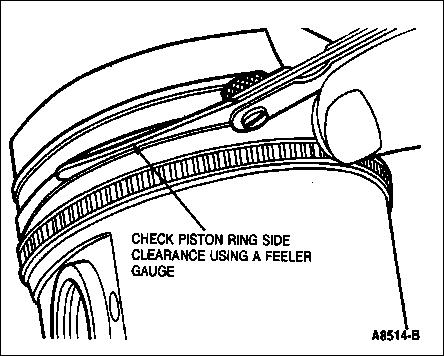
Ring side clearance: Checked with a feeler gauge, if a worn or wrong ring is fitted then they do not work properly.
Groove depth: Carbon buildup can reduce groove depth.
Ring end gap: Measured by putting the piston in the cylinder with the ring on and measuring the gap. If the ring gap is too big (from wear) compression can be lost.

Worn piston ring

Connecting rods:

Con rods are under huge strain and can suffer twisting and bending from the forces of piston movement and transmitting linear motion to rotational motion. If a con rod is bent or twisting it can increase the amount of wear on the engine and piston, or even break under strain. Bending can be repaired to a certain degree. Twist is measured on a flat face with a special tool.

Bent con rods from immense strain.

Crankshaft

The crankshaft is visually inspected and measured to determine if it is damaged or worn. As the crankshaft has a lot of force applied on it, It can suffer wear and surface damage. Cuts on the crankshaft can damage the con rod bearings. and if the wood roff key is damaged, components may not work properly. The Crankshaft journals are measured for wear taper and ovality. If the journals are worn, the crankshaft may not spin correctly or the con rods travelling on the big end journals could wear more aggressively. Measurements are taken (by micrometer) at each end of the journal and at both axis. Crankshafts are also measured for Deflection. This is the 'twisting' of the crankshaft that comes from the torque applied to it over time. It is measured with a DTI gauge and small measurements are recorded.

A lot of force is needed to break a crankshaft.

Cylinder block:

The cylinder block is visually inspected for cracks, corrosion and general damage sustained during use . A crack or corrosion can compromise the strength of the block and make it degrade faster. The Distortion of the cylinder block face is measured with a straight edge and a feeler gauge across different parts of the face. If the Cylinder block face is distorted then the cylinder head may not sit properly or combustion could be lost.
Broken bolts or threads can make the block weaker.

Timing gears, sprockets and belts. 

Because the timing gears are essential to the running of the engine, they are important to check for damage and wear. Worn gears could upset the timing or break. A worn belt or chain has the potential to wreck an engine if it breaks. Chains are checked for worn links, corrosion or tension, and belts are checked for fraying, cracks,corrosion, brittleness and tension. 

A broken Cam belt

And the results, valves left open can be bent by rising pistons.

Core plugs: 

Core plugs are checked to ensure they are doing their job, plugging holes in the block made during casting, and also provide a pressure release if the water in the jacket freezes. If they are corroded they could leak. If they fall into the water jacket they can obstruct water flow.

Oil pump

The oil pump pumps oil from the sump to parts of the engine that need lubricating. If the oil pump breaks the engine could seize due to lack of lubrication. The clearances of the pump impeller and housing are measure with a feeler gauge to ensure they are in manufactures specifications and are not leaking.

A rotary oil pump that has broken its housing.

Bearings and caps

The crankshaft and con rod bearings are important as they help reduce wear on the engine and increase its lifespan. They can be replaced instead of larger parts. Bearings are checked for visual damage and oil galleries are not clogged.

Main bearing and big end bearing oil clearance

Measured with a palsti gauge, the plastigauge measures the gap for oil to pass through and lubricate the bearing, if the gap is too small the bearing could seize.

Crankshaft float

The thrust movement of the crankshaft is called crankshaft float. this reduced by thrust bearings. The float is measured with a DTI gauge. Too much float can wear the crankshaft or result in poor operation.

Con rod play

Con rod play is the thrust movement between the conrod and crankshaft big end bearing. A feeler gauge is placed in the gap to measure the thrust of the con rod. if the gap is too big the con rod can be under more stress and the piston can be worn more.


Thursday, July 7, 2011

Trailers

Trailer types:

Simple single axle boat trailer

 Single axle:

This is the smallest type of boat trailer, Usually made for carrying small pleasure craft under 15 ft. This trailer makes boat ownership easier for more people. 

Double Axle:
 
A double axle trailer is for Larger boats. Four wheels means that the larger weight of the boat is spread onto a larger surface area. Double axle trailers usually contain a braking system as there is more weight extra breaking power is necessary.


Triple axle:

This type of trailer is only for the largest of boats. Boats larger than this usually cannot be taken in and out of the water. This type of trailer is uncommon in New Zealand.


Trailer design:
A frame design:

An A frame boat trailer is the simplest type of boat trailer, however it is a strong and easy to fabricate design. 

A simple trailer for a sailboat

Draw bar:

A draw bar type trailer, utilises a simple frame design and a draw bar. This is a moving attachment to a trailer which allows a better turning ability. 


Trailers are often personalised to individual boats, this is because of different hull shapes and different sized boats.

Bunk Type trailer:

A bunk type trailer is a trailer with a solid skid for the boat to rest on.

Roller type trailer:

A roller type trailer has rollers that allow a boat to easily be retrieved from the water, this also reduces the damage to the bottom of the hull. the rollers are prone to corrosion as water can become stagnant.
A tandem roller type trailer

Trailer materials:
 
Trailers are made of highly corrosion resistant materials, as they have to be submerged into salt water constantly. Usually stainless steel or mild steel with galvanising layer to protect it. Galvanisation is the process of protecting metal from corrosion by bonding a layer of metal over the original metal. 
Aluminium is also used as trailer material as it is light and is resistant to corrosion.
OVERALL DIMENSIONS & RULES

  • If you own a boat you can tow a trailer that can be 2.5m wide, up to 4.25m high when the boat is sitting on the trailer, and 11.5m long, assuming that the car plus the boat doesn't exceed 20m which is the limit.
  • When you load your trailer the I deal position is to have the weight is so about 10% of the weight is taken on the tow ball and the rest supported and distributed over the single/tandem axles of the trailer. If there is to much weight on the tow ball the trailer coupling will not be parallel to the ground therefore the car will be hard to steer (and good luck pulling your boat up a steep launch ramp if the car is front wheel drive). If the load is to far to the back of the trailer  it will have the tendency to fish tail around at certain speeds.
  • Another thing to consider is what gear you have in the boat, “is it heavy” if so where is the weight adding to the load.
  • The tongue of the trailer is also very important – the A-frame design has the coupling of the trailer where the apex of the frame meets.
  • The draw bar style has a strut running through the apex of the A - frame which extends out further and is attached to the tow bar by a coupling.
Trailer Weight Estimates
This chart relates to single axle trailers only
Trailer
Capacity
No.
Axles
Trailer
Length
Trailer
Width
Weight
1000 lbs.115'4"62"295 lbs.
1500 lbs.115'4"62"305 lbs.
2000 lbs.117'2"88"492 lbs.
2450 lbs.118'2"96"522 lbs.
2999 lbs.118'2"96"625 lbs.
3500 lbs.119'8"96"677 lbs.
5000 lbs.120'8"96"933 lbs.
7000 lbs.127'9"96"1512 lbs.

Suspension types:

Boat trailers can utilise a number of suspension types. Leaf type springs on boat trailers are quite common as they can deal with the weight of heavy boats. Leaf type suspension is susceptible to corrosion though as water can get caught in the crevices between suspension leaves.


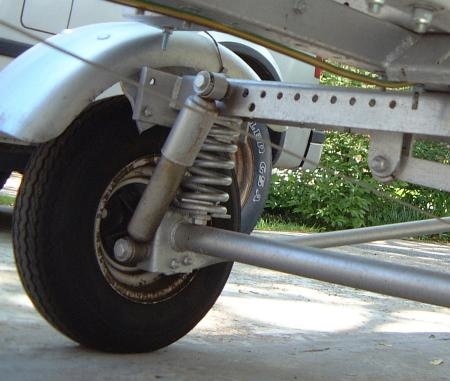
Another type of suspension is the strut type, this is a sealed unit so it does not suffer the same problems with corrosion however the strut type cannot support as much weight as the leaf type, so is  used on small single axle trailers.


Wheels and tyres:

The wheels on a boat trailer suffer from corrosion as they are submerged when the boat is being loaded. salt can build up and crystallise in the crevices on the wheel and tyre. Salt can also degrade the rubber in the tyre.

Brakes:

Boat trailers that haul a large boat must have a braking system. The weight of a large boat is too much for the towing car to safely control. they are controlled in conjunction with the towing vehicles brakes. These also suffer from corrosion as salt water degrades them.


These brakes are also activated by a cable much like a hand brake when the boat trailer is stationary.


Hubs and stubs:

Wheel hubs are usually galvanised to protect them from corrosion, wheel stubs can seize if crevice corrosion takes hold. so are protected with galvanisation.


Lights

The lights on a boat trailer are connected to the towing vehicle by a wire, brake lights and indicators are controlled in conjunction with the towing vehicles lights, as a long trailer could obscure the vehicles lights.
the electrical coupling is waterproof to prevent failures. 
 

Coupling


simple coupling and electrical connection.

Winches:

A winch on a boat trailer is used to haul the boat in from the water. on small craft a hand winch can be operated, but for larger craft a high torque electric winch is required.

A hand operated winch

an electric winch


An extreme case of moving a boat by trailer.


Wednesday, July 6, 2011

Two stroke engines

Two stroke motorbikes dominated the sport for decades

Two stroke engines are a type of internal combustion engine, it was invented by Scottish engineer Dugald Clerk in 1881. The principle of a two stroke engine is that the process of intake, compression, power and exhaust is completed in two strokes of the piston, compared to an engine with four strokes. The result is a very high power to displacement ratio, potentially even double the power from a similar sized four stroke.. Two stoke engines come in all sizes and also come in diesel variations. When two strokes were introduced they quickly became popular on motorbikes for their power to weight ratio, alternatively diesel two strokes became popular in Trains, large boats, and power generation applications.

Ridiculous double two stroke engine drag bike.

Explain how a two stroke engine works?

As mentioned above a two stroke works completes the internal combustion process in two strokes. Also different to a four stroke engine is the intake and exhaust system. A two stroke engine utilises ports or openings in the cylinder to deliver fuel and remove exhaust.

The two stroke cycle

The piston in a two stroke engine also acts as a valve, the up and down movement of the piston uncovers the intake, exhaust and transfer ports at precise moments. Some two stroke engines has different systems but most operate on the principle. Fuel and air mixture coming from the carburettor enters the cylinder through the intake port below the piston, this mixture enters the crankcase and is pressurised by the cylinder which is now on a power stroke. The downward motion of the piston now uncovers the transfer port, this port transfers fuel-air mix from below the piston to above the piston. This intake also helps expel the the exhaust from the last power stroke. The piston now on its upward stroke covers all of the ports and compresses the fuel air mixture, when the piston reaches T.D.C the spark plug ignites the fuel and the process begins again.


Although a two stroke engine has power and simplicity, there are some disadvantages, the largest of these problems is scavenging. When the piston in a two stroke engine is on it's power stroke there is a point where both the intake and exhaust ports are open, the exhaust gas is 'pushed' out of the cylinder by pressure and the incoming intake of petrol, some of this petrol mixture will also leave through the exhaust port, this is known as scavenging and can make a two stroke engine emission heavy as rich fuel is being wasted and sent into the atmosphere. efforts to limit scavenging include shaping the head of the piston to direct the incoming air-fuel flow upwards into the combustion chamber, this does not stop the problem though. In the 1980's and 1990's many countries implemented strict emission controls on vehicles, this effectively ended petrol two stroke engines being made widespread. Two stroke petrol engines are still common in marine applications and some motorbikes.


While two stroke petrol engines have lost popularity the two stroke diesel engines have maintained their popularity. Some of the biggest and most power full engines in the world are two stroke diesel engines, they maintain the simplicity and power of a two stroke petrol but a diesel two stroke does not suffer form the problem of scavenging. This is because a diesel only allows air to enter the cylinder when the intake port is open and the exhaust is not a port but multiple valves, because fuel is injected into the cylinder with a high pressure injector and ignited by the hot compressed air there is no chance of fuel escaping the cylinder unburnt. A diesel follows the same cycle as a petrol but air is forced in with a supercharger (compulsory on a two stroke diesel) and exhaust is pushed out of the exhaust valves by the rush of incoming air.

Diesel two stroke for a Large ship

What is happening below and above the piston?

Above the piston is the inlet of fuel through the transfer port, the compression of that fuel, and the ignition of that fuel resulting in a power stroke. Below the piston is the inlet port where fuel-air mix enters through a reed valve, then the mixture is pre compressed by the downward motion of the piston, the mixture then travel through the transfer port when the port is uncovered.

Why must roller and ball race bearings be used on 2 stroke SI engine crankshafts?

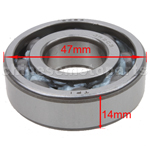
Because a two stroke engine is a sealed unit there is no way for oil to be circulated to lubricate the parts. Lubrication in a two stroke is done by the fuel entering the system. two stroke fuel contains a preset amount of oil which lubricates the parts and bearings of and engine before it is ignited, this oil also cause some of the emission problems that two strokes have. The reason for ball race bearing is so this oil can penetrate between the ball bearing and lubricate them, if this was a closed bearing the oil would not perform it's job and the engine could seize.

Two stroke ball race bearing

Why are rollers caged in crankshaft bearings?

Crankshaft roller bearings are caged to prevent the individual rollers from moving around the big bearing. The constant movement of the bearing from the piston would make the rollers bunch together on the bearing leaving some surfaces with no roller protection.

Roller bearings of different sizes

Why must ‘split’ type bearings be used on one piece crankshafts?
A one piece crank shaft cannot be disassembled, the bearings on the centre of the crankshaft need to be replaced after an amount of time as they suffer engine wear. This is the reason for the split bearing, it can be split and removed from the crankshaft and replaced with a new bearing.

Split type caged roller bearing

Why do we have pins between the piston ring gaps on a 2 stroke?

A pin on the piston stops the piston ring from moving around the piston. the repeated motion of the piston can move the piston rings and in a two stroke if the piston ring gap is in the wrong place then this could cause pressure loss.

A piston with piston rings, gudgeon pin and piston ring pins.

How does a reed valve work on a two stroke?
A reed valve is a type of one way valve. It is essentially just a flap that opens one way. They are used on a two stroke engine to allow the entry of fuel i the crankcase. The movement of the piston creates a vacuum this vacuum 'pulls' air and fuel through the reed valve when the vacuum stops the valve closes.

A two stroke reed valve

How do you check a reed valve?
The constant opening of this flap can damage the reed valve where it becomes inefficient and does not close properly. Dirt can also make the valve not work properly. The reed valve can be checked by holding it up to light and inspecting it, if there is a gap the reed valve needs repairing or replacing.

Explain the term ovality and taper and how are they formed?
Taper and Ovality are terms for wear in the cylinder bore of an engine. Due to the constant stress that an engine operates with the cylinders and bore are subjected to wear. Taper is the wear which makes the cylinder bore taper or wear outwards, It is caused by the constant sideways movement of the piston translating linear motion into rotational motion. Ovality is the wear on a cylinder bore which turns the circular bore into a more oval shape, this is again because of the repeated movement of the piston.

an example of cylinder bore wear

How does the piston rings seal in the bore?
The piston rings purpose is to ensure there is a seal in the cylinder around the piston, and to transfer heat from the piston through convection to the cylinder block. Without a proper seal much power would be lost and proper compression would not be achieved. They achieve this seal due to the ring pushing the bore and also due to the rings design. When combustion happens in a cylinder some of the force of combustion goes in the piston ring gap and behind the piston ring and force the ring into the cylinder bore creating a strong seal. the piston ring also prevents excess oil from being burnt in combustion.

Another example of cylinder wear

What is meant by the terms groove depth, side clearance and end gap on the pistons rings?
Groove depth:

This is the depth of the groove that the piston ring sits in. This groove is prone to carbon build up and effect the piston rig operation.


Side clearance:

This is the amount of space that is between the piston ring and the piston groove wall, this is measured with a feeler gauge.


End gap:


This is the size of the gap that is on the piston ring, this gap can change due to the changing ductility of the ring. This is measured with a feeler gauge while the ring is in the cylinder to determine it's natural position.


Explain the difference between a 2 stroke and a 4 stroke engine?
While they are both internal combustion engines there are several differences between a four stroke engine and a two stroke engine, the main differences are in the fuel delivery systems. A two stroke engine completes the engine process of intake,compression, power and exhaust in two strokes of the piston that is one movement down and one movement up. As mentioned above a two stroke utilises the movement of the piston and intake and exhaust ports on the cylinder bore to deliver the fuel to the system, as opposed to the valve system on a four stroke. The fuel in a two stroke engine, unlike 4 stroke, also contains oil as the engine is a sealed unit and needs lubrication. Two stroke engines are predominantly air cooled because of their simplicity, apart from marine two strokes.


What is meant by each of the following terms:
Mechanical Efficiency:

Mechanical efficiency is a term used to describe how efficient a machine is (in this case an engine) 100% efficiency would mean that all of the energy produced by the engine would be used, this is quite impossible though as engines lose energy through friction heat and noise. 

A maglev train has very high mechanical efficiency as the train does not come into contact with the rails and is sitting on a 'cousion' of  magnetic field. The electromagnets on the train are propelled by the opposite
 magnetic force from the magnets on the track.

Thermal Efficiency:
Thermal efficiency is a measure of the amount of heat produced by a machine, and how much of that heat is wasted. This figure is put into a percentage of thermal efficiency.

Volumetric Efficiency:
Volumetric efficiency is a measure of the movement of a fluid ( air, fuel) into a space. In internal combustion engines this is how easy it is for a charge to enter or exit the cylinder. This efficiency can be increased by removing bends in intake and exhaust pipes. A turbo charger decreases volumetric efficiency by slowing down the exhaust gas leaving the engine to drive the turbine, however makes up for this energy sap with the power it produces.

List 2 methods of lubricating the internal parts of 2 stroke S.I. engines?


As mentioned before may two stroke engines have oil in the fuel which lubricates the engine parts. Another method of lubrication is having a wet sump, this system utilises oil that is poured into the crankcase and is a high enough level that the crankshaft and big end bearing are submerged at BDC, the movement of the piston splashes oil up on to the walls of the cylinder and the piston. In four stroke engines the oil is pumped to the top of the cylinder.

This is a four stoke system.

What happens if the piston gap is too big?

If the Piston ring gap is too big then the cylinder could lose compression due to the large gap on a piston ring. 

What happens if the piston gap is too small?
If the gap is too small then the piston ring will not be able to expand as much. If the piston ring cannot expand then it may not seal the bore properly, leading to poor compression.

Although Two stroke engines have lost some popularity due to emission constraints they are still a popular choice for small engines like chainsaws as they are very simple and easy to produce and they can operate sideways or upside down due to the ports. Nearly all of the biggest ships in the world use low speed two stroke diesel engines, so in a way two stroke engines have revolutionised the world by allowing goods to be
transported vast distances efficiently.

You got to have balls to ride death machine like a two stroke racing bike


References:

http://en.wikipedia.org/wiki/Two-stroke_engine

http://science.howstuffworks.com/transport/engines-equipment/two-stroke.htm

http://auto.howstuffworks.com/diesel-two-stroke.htm

http://en.wikipedia.org/wiki/Volumetric_efficiency

http://en.wikipedia.org/wiki/Thermal_efficiency

http://en.wikipedia.org/wiki/Mechanical_efficiency

http://en.wikipedia.org/wiki/Piston_ring