Monday, July 4, 2011

Corrosion

Corrosion in marine engineering is the degradation of parts on a boat due to the environment, or external forces. This is one of the biggest problems to deal with when designing and maintaining a boat. Because Boats generally are exposed to water, and air that is heavy with salt, the metal parts of a boat are venerable to corrosion unless they are protected. Metal parts on boats are usually made out of metals with good corrosion resistance, and other metals can be protected by methods like: Galvanisation ( when a metal is coated over another metal to protect it ) and other methods.

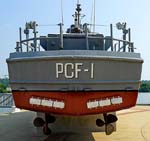
Corroded aircraft carrier being sent to become scrap metal.

What is cavitation corrosion?

Cavitation corrosion is a type of corrosion that fatigues a material by creating small cavities in the material. This is usually caused by liquid moving through a pipe or over an object. The corrosion is created by a liquid changing direction rapidly and wearing the metal like in pipes, or when bubbles created by a pump or impeller strike a surface repeatedly and cause cavities. Cavitation corrosion in engineering is a big problem because the cavities can weaken a material to the point where it breaks or leaks. The effects can be lessened by smart engineering and understanding water flow ie by limiting the number of sharp turns in a pipe or reducing bubbles with a different impeller in a pump or a different propeller on an engine.

Corrosion in a pipe.


Cavitation on a propeller, bubbles are created by the cavities
What is galvanic corrosion?
When two dissimilar metals are electrically connected one of those metals will corrode more than the other, this is the basis of anodes. Metals are ranked on their corrosive resistance on the galvanic scale at the top the most resistance at the bottom the least resistant to corrosion. Essentially the lower resistant metal will take almost all of the corrosion from the more 'Noble metal'. Certain metals work far better when connected than others.
http://en.wikipedia.org/wiki/Galvanic_series
This poor piece of engineering, with no regard for the galvanic scale, Has left the metal on the right completely corroded and the other metal relatively free of corrosion.

Describe the terms:

Stray corrosion?

Stray corrosion is where metals that are not directly attached to a galvanic system, are corroded. Electrical current can travel through objects and corrode other metals in the immediate area.

Stress corrosion?
Stress corrosion is the long term wearing of a material due to forces and stress on the part. A metal that originally was very high in tensile strength can become ductile after repeated stresses and can eventually suddenly break. Stress corrosion also effects rubber pipes by cracking and fraying the edges.

Bolt can crack suddenly after repeated and long term stress

Corrosion Fatigue?
Corrosion fatigue is the degradation of a material because of: the environment with corrosive substances and: repeated stresses such as the stress that and engine creates on the materials.

Crevice corrosion?
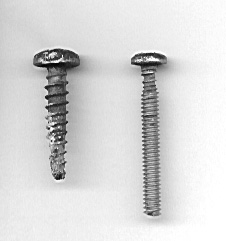
Crevice corrosion happens when a corrosive substance like water is trapped and stagnant in a crevice or crack. the most common place for crevice corrosion is under the heads of bolts where water can accumulate.

The  screw on the left has been corroded by crevice corrosion.

What is Electrolysis?

Electrolysis is a chemical change that happens when an substance (like water) has an electrical current passed through it. Essentially the water is separated into the different elements that make up water.

How do you prevent corrosion?
Corrosion can be prevented in many ways, the marine industry employs may of these methods to reduce the effect of corrosion on boats. One of the most common methods is Galvanisation. This is the process of applying a protective metallic coating to an underlying piece of metal, to protect it from rusting. The protective coating is usually made of a metal with a high corrosion resistance, when this metal is corroded the piece can be galvanised again to protect it further. Another method is the use of anodes to protect a metal hull or other parts. An Anode is essentially just a sacrificial piece of metal that when connected in an electrical circuit with a hull 'draws' corrosion away from the other metal. It works on the principle of galvanisation where one metal is severely corroded and can be replaced to protect the hull, changing an anode is far easier than changing a hull!
Zinc anodes can be seen on the hull below the water line.
What is bonding in the marine industry?

Bonding is the system of keeping electrical components of a boat isolated from one and other. the reason for this is when marinas are full of boats there can be a lot of DC current in the water this can degrade the anodes on a boat very rapidly, by isolating electrical currents the anodes can be spared.

http://www.sailmail.com/grounds.htm
What are sacrifical anode made of?
A sacrificial anode is usually made of zinc or any other metal that is low on the galvanic scale, this ensures that corrosion will be directed to the less noble metal. Anodes should be replaced when half of the anode has been degraded, the anode will lose efficiency the more degraded it is.

Large Zinc sacrificial anodes for boat hulls.

References:

http://www.yachtsurvey.com/corrosion.htm

http://www.kastenmarine.com/corrosion.htm

http://en.wikipedia.org/wiki/Galvanising


Diesel Engines

 
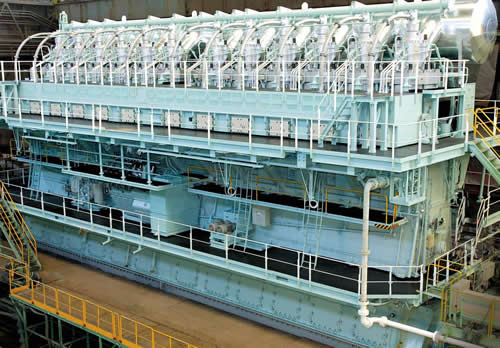
The largest Diesel engine in the world

A Diesel engine is a type of internal combustion engine that utilises high compression ratios and fuel injectors to create compression-ignition. Diesel engines are quite simple in design, utilising many common parts with a petrol engine, but instead of a spark plug as the source of ignition, diesel fuel being injected into the combustion chamber is ignited by the very high temperature of the compressed air in the cylinder. Diesel engines are typically more robust and parts are much stronger to deal with the increased pressures and heat of the very high compression ratios. Compression ignition is generally a very efficient form of  internal combustion engine, far less heat is wasted in a diesel engine when compared to a piston engine, for this reason modern diesel engines are now becoming more common in passenger cars after years of being shunned in favour of petrol engines. Diesel engines had a reputation for being dirty which is only just being changed. In contrast the diesel engine has become almost universal on trucks, construction machinery, large marine applications, power generation, and types of trains. Diesel engines produce very high amounts of torque and low end power which is necessary on heavy machinery.

An Audi V12 common rail TDI diesel engine

History of the Diesel engine

The Diesel engine was developed by Rudolf Diesel a German inventor and engineer who, with a knowledge of thermal engineering created a compression ignition engine in 1897 that was to become the diesel engine. Rudolf diesel found out that the petrol engine, which had only been invented  fairly recently, was very inefficient in combustion utilising only about 25% or less of the heat created, the rest of the heat was wasted. He developed the diesel engine and eventually gained a efficiency of 75%, this success led to the diesel engines being adopted for applications that previously employed steam engines which were far more inefficient than diesels. Because of the weight of the robust diesel engines it was not widely used or at all in aircraft or passenger vehicles, but was used in everything from power stations to submarines, the slow and constant power made it ideal for large heavy ships. Modern Diesel engines are now highly developed and are reaching an equivalent power to a petrol engine with great efficacy.

The Audi R18, winner of Le Mans 24 hour, is an example of an efficient, powerful diesel engine.

What fuel pressure would you get from a diesel pump?

A diesel injection pump supplies the diesel injectors with fuel via a camshaft system. Because of the incredibly high pressure in the cylinder of a diesel engine, the injectors need very high fuel pressure to enter the cylinder. a Diesel pump typically provides up to 15000 psi in fuel pressure or more, even reaching up to 30000 psi. Extra care must be taken when working with high pressure pumps.

An in line diesel injection pump

How does a diesel pump work? and why do you need to time the injection pump?

As mentioned above a diesel pump works by metering the amount of diesel fuel being sent to the injectors by using a camshaft operated line of cylinders, these cylinders draw in and expel fuel to the injectors by the movement of the camshaft. The injection pump needs to be timed because if it is not timed correctly the injectors will not be receiving enough fuel or too much fuel, diesel fuel will be sent to the injectors at the wrong time and may cause damage due to the high pressures that the pump creates.
A rotary type injection pump, typically used on passenger cars.

How do you time an injection pump and what equipment do you use?


1)      Take the diesel pup off the engine.  
 
2)      Confirming the timing belt timing
a.       Getting the engine to TDC using the timing mark on the flywheel
b.      Getting the cam to TDC using the cam lock
c.       Getting the injection pump to TDC using the pump lock

3)      Setting the injection pump timing
a.       Inserting the dial indicator (DTI gauge)
b.      Rotating the engine backwards (counter clockwise) until the dial indicator stops moving
c.       Zeroing the gauge
d.      Rotating the engine forwards (clockwise) to exactly TDC
e.       Reading the timing value on the dial gauge
f.        Adjusting the pump timing, if required
4)     Putting it all back together

http://vincewaldon.com/index.php?option=com_content&task=view&id=24&Itemid=28
A DTI gauge, used to time the injection pump.
  What is the purpose of glow plugs? and how do you test a glow plug circuit?
 A glow plug is essentially a heating element that is mounted in a diesel engine in the combustion or indirect combustion chamber. Because diesel engines rely on very hot compressed air to ignite the fuel, diesels can have trouble starting in cold conditions. the air in the cylinder is too cold for ignition and fuel can be wasted trying to heat the engine up enough. The purpose of the glow plug is heat up the air in the cylinder with it's heating element enough for combustion of fuel. A glow plug can be tested by either checking the resistance on it through a multimeter, or applying a current to the glow plug and monitoring the colour change and amperage of the plug. a glow plug can lose it's effectiveness over time, by not heating enough.


What is the purpose of a lift pump on a diesel engine?

A lift pump functions to raise the level of fuel or other liquid up through a given system. In automobiles, the fuel lift pump works to build pressure or suction in the gas tank, thereby encouraging the fuel level to rise to the injection systems and on to the engine block


http://www.ehow.com/list_6039762_differences-lift-pump-fuel-pump.html

A simple mechanical lift pump

 What is the purpose of the electronic fuel shut off valve?

A diesel engine unlike a petrol engine does not rely on an electrical system to create ignition, this means a diesel engine can run as long there is a fuel source. The electronic fuel shut off valve is a mechanism that ensures the fuel to the engine shut off as soon as the ignition switch is turned off. Without this valve the diesel engine could potentially keep running and destroy itself.

A simple solenoid stops the flow of fuel to the engine

What is the knock sensor for and where is it situated?
A knock sensor on a diesel engine is for monitoring the time of ignition. A knock sensor can detect early injection or ignition and can relay this information to the ECU which can adjust the ignition timing.

A knock sensor position on the cylinder block.

How do diesel injectors work?

Diesel injectors in modern diesel engines are one of the most important parts of a diesel and are increasing in complexity. There are mechanical and electronic fuel injectors, as well as indirect and direct. A mechanical injector uses the fuel pressure built up in the fuel lines by the diesel pump to overcame a spring seat which releases diesel fuel at high pressure into the combustion chamber. In an electronic system a solenoid inside the injector activated by the ECU opens and sprays fuel into the combustion chamber. As the compression ratio and pressure is very high in a diesel engine, a diesel injector has to be very strong to deal with extreme stress. Direct injection is when diesel fuel is sprayed directly into the combustion chamber from the injector, this is common on modern diesel engines. Indirect diesel injection utilises a pre combustion chamber, fuel is injected into this chamber then travels through a port to the primary combustion chamber.

Electronic Fuel injector

Why is it necessary to bleed a diesel engine after replacing a fuel filter or removing the pump?

When replacing the fuel filter or fuel pump the fuel lines are exposed to air, Diesel injectors are very precise and diesel fuel must be filtered and free of contaminants before it will run freely through the injectors. If air enters the fuel system then the engine will not run as the air is contaminating the fuel. bleeding the system removes the air and purifies the fuel.


How do you bleed a diesel system?

To bleed the fuel system air must be expelled, this is done by loosening the injectors on the engine and pushing the manual fuel pump or cranking the engine over to pump the fuel system and expel the air, when fuel starts spraying out of the loose injectors the system is clean and the injectors can be tightened.

How does a Turbocharger work?

A turbocharger is essentially a pump that increase the power of an engine by forcing air into the intake manifold and cylinders allowing more fuel to be injected, a process called forced induction. The turbocharger is made of two turbines one turbine is driven by the hot exhaust gases leaving the exhaust manifold, this turbine drives the second turbine via a shaft. This is turbine acts as a compressor and draws large amounts of air in, compresses it and forces it into the intake manifold. A turbocharger offers big increases in engine performance, an engine some modifications to equip a turbocharger notably the intake and exhaust manifolds and gaskets to deal with the extra pressure generated.


Why are Turbochargers commonly fitted to diesel engines?

Turbochargers are in common use on diesel engines. The reason is that diesel engines, with much lower speeds and generally lower power at high speeds, are well suited to be improved by a turbocharger. Installing a turbocharger on a diesel engine can increase the spread of  the engines torque and power band, meaning the engine can perform better in more situations. as well as improving power, the turbo can improve fuel economy, and noise and vibration levels.

A turbo diesel system

How does a supercharger work?

A supercharger is similar to a turbocharger, it is a compressor pump that compresses air and gives an engine forced induction. Superchargers come in different types but they are all powered by a gear, chain or belt running directly from the engine. superchargers provide extremely high performance figures, but some of the horsepower created by the supercharger is used to spin the compressor turbines, in some cases as much as 40% engine power. An engine needs to be modified to mount a supercharger and to deal with the increased pressures and stress. Superchargers were originally invented for industrial purpose but were soon adapted to internal combustion engines.

A roots type supercharger

What is the difference between a turbocharger and a supercharger?
Turbochargers and superchargers are both forced induction systems which increase engine power and performance. The main difference between the systems is the way the compressor is driven. In a supercharged system the compressor turbine is driven by a Direct link to the crankshaft (Belt, Chain, or a Gear). A turbocharger however uses the power of the exhaust to drive the compressor turbine. The advantages of a supercharger over a turbo charger are: Direct power, because the compressor is attached directly t the crack shaft there is no power lag. A supercharger is also far simpler than a turbo and the parts are not under the intense heat and strain that a turbochargers parts are. A supercharger is disadvantaged by the amount of power need to run the compressor which can sap engine power. A turbocharger provides very high power and performance upgrades with relatively little modification, and does not sap as much power as a supercharger, however turbochargers can suffer from turbo lag. At low engine speeds not enough exhaust gas is being produced to drive the turbo impeller, therefore the turbo is not working properly, this can be a big problem on cars with large turbos. The problem can be lessened by staging turbos or having sequential turbos, where one turbo is in operation until a larger turbo has enough exhaust gas to run properly. Another problem with turbos is that the parts of a turbo are under immense heat and strain, leading to increased wear.

Top Fuel dragsters use huge superchargers on very powerful engines to achieve up to 10,000 horsepower or more

Why are inter coolers fitted to engines?

An inter cooler is essentially a radiator fitted to engines with forced induction. The inter cooler cools down air after it has left the turbocharger but before it has entered the engine. Cold air is more dense than hot air so more cold air can fit into the combustion chamber, this is how an inter cooler increases engine performance. An inter cooler also reduces the chance of knocking in the engine as hot air from the turbocharger could make early detonation possible.

Flow of air in an inter cooler.


What is the purpose of an governor?
A vital component of any diesel engine system is the governor, which limits the speed of the engine by controlling the rate of fuel delivery. A Governor can protect a diesel engine from damaging itself by setting a maximum and minimum rpm, either mechanically or electronically.

What is the difference between a diesel and a common rail diesel?
 
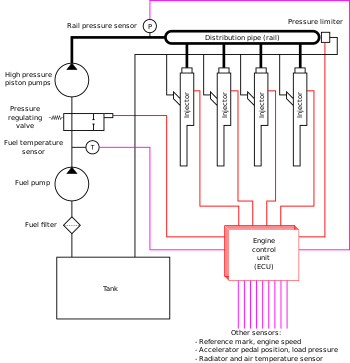
The differences between a diesel engine and a common rail diesel are in the fuel delivery methods. On a normal diesel engine fuel is drawn from the fuel tank by the diesel fuel pump and sent through the fuel lines to the injectors where the fuel is either released by a solenoid (electronic) or a spring (mechanical). In a common rail diesel engine, a high pressure pump supplies fuel to a rail which is attached to all of the injectors on a cylinder bank. The fuel in the rail is kept at a very high pressure (up to 29000 psi) this rail acts as a reservoir for fuel and ensures that all injectors are supplied with high pressure fuel. A fuel return line with a pressure limiter attached to the common rail ensures that during periods of low engine loading fuel can flow back to the tank and not damage the rail. Most modern diesel engines run with a common rail system.

a common rail system

Diesel Engines are now finally receiving recognition by the wider public, modern diesel engines are among the most efficient in the world and continue to be developed.

Volvo trucks are some of the most powerful in the world.

References:
http://en.wikipedia.org/wiki/Injection_pump

http://en.wikipedia.org/wiki/Diesel_engine

http://www.howstuffworks.com/diesel.htm

http://en.wikipedia.org/wiki/Glowplug

http://www.duramaxforum.com/forum/performance-upgrades/23591-lift-pump-what-does-actually-do.html

http://www.ehow.com/list_6039762_differences-lift-pump-fuel-pump.html

http://www.canadianyachting.ca/index.php?option=com_content&view=article&id=483:replacing-the-fuel-filter-and-bleeding-the-fuel-lines&catid=29:maintenance&Itemid=44

Wednesday, June 15, 2011

Fuel injection

Fuel injection is a system of delivering fuel to the combustion chamber in an internal combustion engine. Fuel injection has almost completely replaced the carburetor in use on engines. with only exception being chainsaws and other small engines. Fuel injection has it roots in the early 20th century when it was designed for use on diesel engines, however it was not seen in usage until the 1930's when German scientists designed a fuel injection system for petrol powered combat aircraft. Carburetor powered aircraft could risk starving the engine in a dive, fuel injection gave German aircraft an advantage for some time. After the war mechanical fuel injection saw limited use in racing cars and aircraft, but was not common on the vast majority of petrol powered vehicles, due to its complexity and cost. Electronic fuel injection also had limited use from 1957 but was also uncommon. After strict emissions regulations were imposed by the U.S government in the 1970s and 1980s Car makers started to remove complex carburetor systems and implement fuel injection, by the early 90s nearly every car being made had fuel injection.

Alfa romeo 6C 2500 One of the first cars with mechanical fuel injection

Fuel injection systems require a large amount of sensors to ensure proper operation, these sensors make sure that the right amount of fuel is being delivered at the right time, here are some examples:

What is the Electronic control unit and how does it work?

The Electronic control unit serves as the control center for all of the sensors on a car. The engine control unit is responsible for monitoring and controlling all the sensors on a cars engine. The ECU monitors the performance of the engine and makes adjustments according to where the problem is. The ECU also does calculations of pulse length (injector time opening) and adjustments to any change in the engine. The ECU can be upgraded and programmed to enhance the performance of the engine.


What is the mass air flow sensor and how does it work?

The mass air flow sensor is a device that is used in conjunction with an oxygen sensor to accurately measure the flow of air into a fuel injection engine. The air flow sensor sends this data to the ECU and it calculates how long the pulse wave should be, this is the amount of time the injector is open regulating the amount of fuel sent to the engine. There are a few ways to measure air flow, the most common in fuel injection engines is the Vane meter sensor and the hot wire sensor. the vane meter uses a spring attached to a potentiometer which measure the voltage and air flow is calculated by the ECU. The hot wire type uses a wire suspended in the engines air stream, an electrical current through the wire heats it up and the air flow cools it down  the air flow is calculated by the ECU using the current required to keep the wire at a stable temperature.

This is a hot wire type sensor


What is the air temperature sensor and how does it work?

The air Temperature sensor is used to measure the temperature of the incoming air in the engines air stream. Warm air is less dense than cold air which means more fuel needs to be added to maintain the air/fuel mixture. The ECU measure the temperature and density of the air and adjust the fuel delivery accordingly.

Air temperature sensor

What is the purpose of the Throttle Position sensor (TPS) and how does it work?

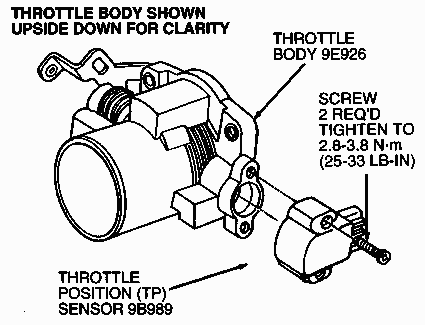
The purpose of the throttle position switch is to relay the position of the the throttle butterfly valve to the ECU. A potentiometer on the butterfly valve measures what position it is in by providing resistance when the valve is opening, the more the valve opens the more the resistance. The ECU monitors this resistance and is able to monitor the position of the valve. The ECU can now keep other sensors on the engine in sych with the opening of the throttle valve. If the valve is opened rapidly more fuel can be injected to prevent the engine from stalling.

Throttle position sensor mounted on throttle body

What is the purpose of the throttle body and how does it work?

The throttle body is a part of the air intake system on a fuel injection engine. The body acts as control for the amount of air entering the engine, by metering the air flow with a butterfly valve called the throttle plate. This valve is connected to the throttle pedal via a wire. The butterfly valve is opened and closed by the wire which allows more or less air into the engine.On a single point fuel injection engine the single injector is positioned inside the throttle body.

What is the purpose of the Temperature sensor and how does it work?

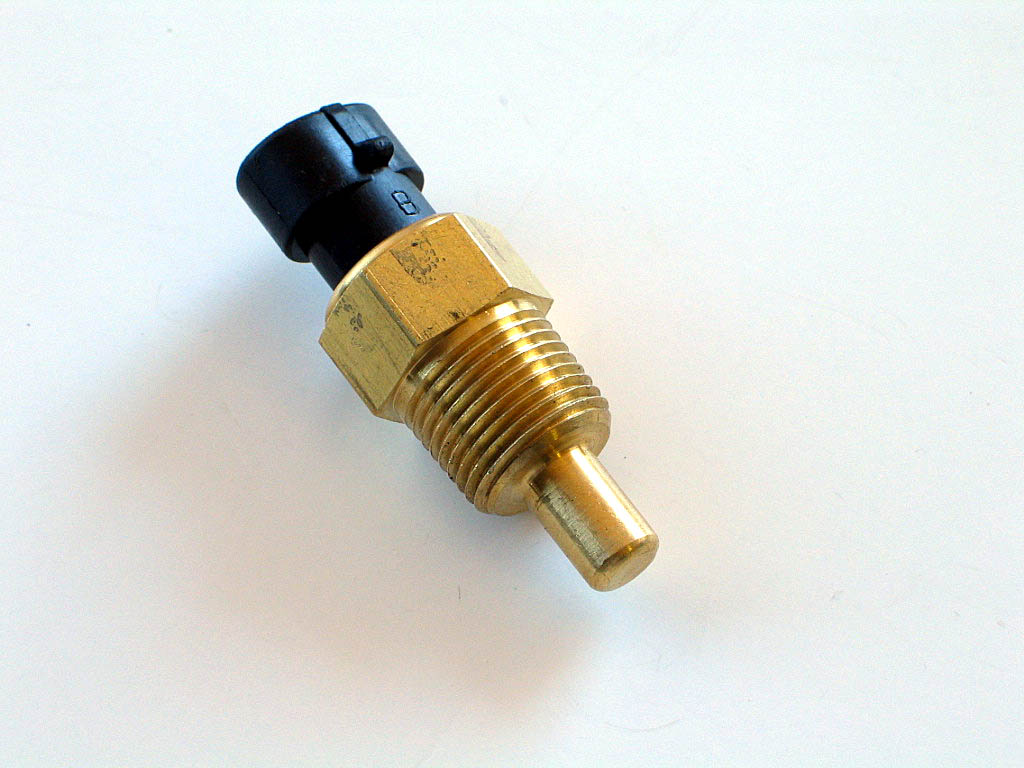
There are various temperature sensors in a fuel injection engine, their purpose is to measure the temperatures of fluids or parts in the engine and report it to the ECU. There are temperature sensors for coolant, air, oil, water and more. The sensors work by recording the temperature and relaying that temperature to the ECU, the ECU can now make adjustments to decrease or increase the temperature of the fluid. An engine has a optimum running temperature which is maintained by the ECU.
Coolant temperature sensor
 
What is the purpose of the fuel rail?

The Fuel rail is a part found on electronic fuel injection engines, its purpose is to provide fuel to the individual cylinder injectors, it also provides a seat for the injector. Fuel is pumped into the rail through a regulator and the right amount of fuel is released by the injectors, if there is too much pressure in the fuel rail then the regulator releases pressure with a return valve.

Fuel rail with injectors

What is the purpose of the fuel pressure regulator and how does it work?

A EFI engine needs a constant fuel pressure in the fuel rail to feed the injectors, the purpose of the fuel pressure regulator is to maintain that pressure. It controls the pressure and releases pressure when it is high.


What is the purpose of Fuel injectors and how do they work?

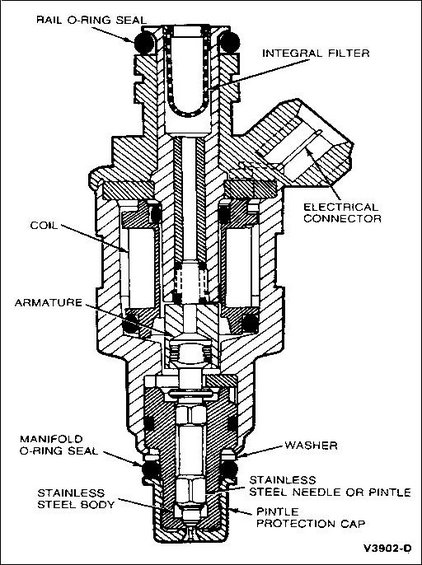
Fuel injectors are responsible for delivering an accurate amount of fuel to the engine from the fuel rail or lines. Injectors need to respond to changes in engine loading by entering more or less fuel in the engine, for this they are connected to the ECU which monitors engine loading and changes the injectors pulse width. this pulse width is the length of time that the injectors are open for. There are different types of injectors like indirect and direct injection. Indirect places the injectors in the intake manifold and fuel is sprayed just before the intake valve is opened, direct injection means the injectors are positioned in the combustion chamber, High pressure injectors spray fuel directly into the cylinder, this is usually used on diesel engines. There are also mechanical and electronic fuel injection systems, in mechanical fuel injection a high pressure pump is used to pump fuel to the injectors when the fuel pressure in the injector is high enough the fuel overcomes a spring system and is injected into the cylinder. In EFI engines a solenoid in the injector which is controlled by the ECU opens the injector at the right time and for the right amount of time. Different spray patterns are also used on injectors to increase combustion efficiency.


What is the idle air control valve and how does it work?

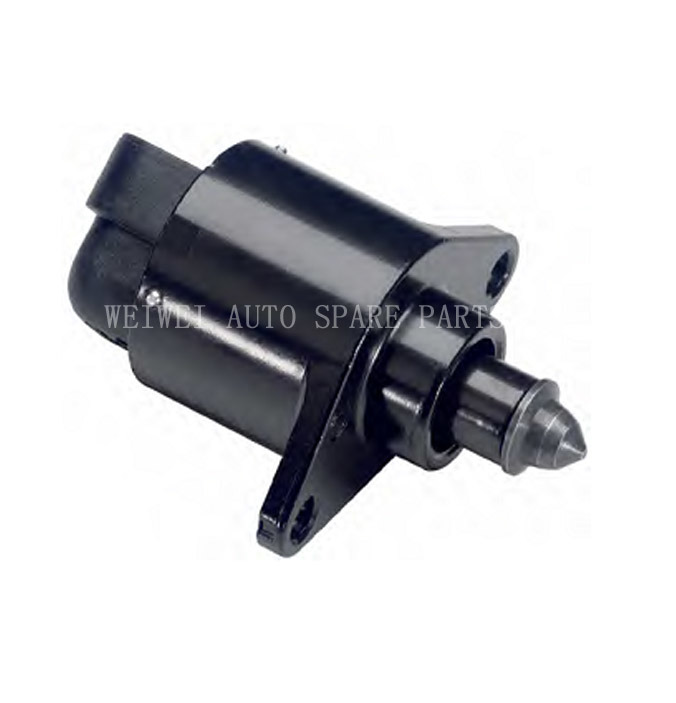
The idle air control valve controls the amount of air entering the engine while idling. The valve is positioned in the throttle body and opens to allow air to bypass the throttle plate when idling and closes when the engine is under load. The ECU controls the opening of the valve this helps regulate the idle speed.


What is the purpose of the oxygen sensor and how does it work?

In all internal combustion engines the right amount of fuel/air ratio is necessary for proper combustion. The oxygen sensor is a device positioned in the exhaust stream which is tasked with measuring the make up of the exhaust whether it is running too lean or too rich. It works in conjunction with other sensors in the engine like the air flow sensor to measure the air/fuel ratio. This information is then sent to the ECU and changes in fuel/air intake are made. The sensor is essentially a voltmeter the amount of fuel in the air/fuel mix changes the voltage, a rich mixture brings a voltage build up, and a lean mixture causes a low voltage.


What is the purpose of the MAP sensor and how does it work?

The purpose of the MAP sensor or Manifold absolute pressure sensor is to provide information about the air pressure in the intake manifold to the ECU. The ECU can use this data to calculate the density of the air in the system, and in turn calculate the amount of fuel needed to achieve efficient combustion. The MAP sensor is placed on or above the intake manifold, it essentially operates as a barometer.


What is the purpose of the plenum chamber and how does it work?

The plenum chamber in internal combustion engines is a chamber situated between the throttle body and attached to the intake manifold, it's purpose is to act as a stabiliser for air flow into the engine. Air intake pulses inside the intake manifold as air is only need on 1 of four strokes, the plenum chamber helps maintain constant air flow by storing air for the next intake and helps dampen the pulsing effect.


What is the purpose of the Crankshaft sensor?

The crankshaft sensor is used to relay the position and speed of the crankshaft to the ECU. Using the data from the crank sensor the ECU can control the ignition and other aspects of engine timing. The crank sensor can also relay the speed of the engine in RPM to the ECU.

What is the purpose of the camshaft sensor?

The Camshaft sensor works on similar principles to the crankshaft sensor. It measures the position and speed of the camshaft to aid the ECU in engine timing.

Explain how Single and Multi injection systems work?

In a Fuel injected engine the fuel is delivered to the intake manifold via injectors. In a single point injection system one injector is positioned inside of the throttle body and provides the fuel for all of the cylinders. This system was used earlier in the development of fuel injection when carburettor engine designs were given small modifications to incorporate the throttle body for fuel injection. Many modern engines use multi point fuel injection, this type of injection has a injector for every cylinder, these injectors are opened by the ECU at the right time. They can be sequential meaning that the injectors open before intake or simultaneous meaning they open all at the same time.


Monday, June 6, 2011

Carburettor assignment

The Carburettor is a mechanical device that is designed to mix air and fuel on an internal combustion engine. For an internal combustion engine to work a very precise amout of air/fuel mixture is needed. the carburettor works with simple principles to obtain this mix. It was invented in the late 19th century for this purpose.

How does a carburettor work?

Two stroke: A two stroke Carburettor is much more simple than a four stroke carburettor. It is essentially a tube that mixes and pressurisers the air and fuel., Air enters the carbuerttor through an adjustable plate called a throttle plate, this is controlled by a wire attached to the throttle pedal. Inside the carburettor is a narrowing tube called a venturi, this pressurises the air by forcing it into a smaller space. Inside the venturi is a jet or jets which use the vaccum created to allow fuel to enter the venturi and mix with air to create the right air fuel mix. This mixture then leaves the carburettor and goes to the engine. A choke can be used to increase fuel flow into the carburettor.


Four stroke: A Four stroke carburettor works on the same priciples as a two stroke carburettor, however it is more complicated as it has to operate under different circumstances. The main differences are: More parts, more complication, different operating demands. A four stroke carburattor contains an accelerator pump which assists in clean fuel delivery and smooth acceleration.


Identify the components in a carburettor:


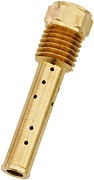
How does an emulsion tube work? and What are the holes in the tube for?:

The emulsion tube meters air and fuel entering the carburettor, the holes regulate the amout of air entering by the change in fuel levels in the tube, under acceleration the holes are uncovered by the fuel going down allowning more oygen into the tube.


How does the manual choke and automatic choke work?

A choke is used to help an engine start when cold. A manual choke works by closing a valve over the air intake of the carburettor, this valve contains a small hole which resctricts tthe amount of air entering the carb, this creates a vaccum so more fuel can be pulled through for startup. An automatic choke works in the same way, but the choke valve is controlled automatically by a temperature sensor.
 Holes on a choke valve

What is the purpose of the float in the Carburettor?

 The float in a carburettor acts to keep the level of fuel in the fuel bowl constant, if the level of fuel drops the float lowers and exposes a pin valve which allows more fuel in.


What is the purpose and how does a mechanical lift pump work?

 The mechanical lift pump is a vaccumm pump that uses pressure to suck fuel from the petrol tank up towards the carburettor. It works by pumping with a diaphram that is run by a camshaft and cam roller.


How does a vacuum fuel pump work on a two stroke engine?
A vaccum fuel pump uses vaccumm created by the movement of the pistons from T.D.C to B.D.C to pump fuel from the fuel tank to the carburettor.


What pressures would you get from these types of pump?
A vaccumm pump depending on its size can be anything from 1 kPa - 50 kPa.

What the difference between petrol and diesel fuel?
Diesel and petrol are both derived from crude oil, using different refining techniques. Diesel fuel has different properties to petrol, the main one being that dielsel is far less volatile than petrol it ignites at a much higher temperature which is required in a Compression ignition engine. Diesel behaves differently to petrol in extreme temperatures with diesel clumping up in the cold.

How does the fuel shut off solenoid work?
A fuel shut off solenoid works by shutting off the supply of fuel to the diesel engine when high temperatures or malfunctions are detected. This is to stop a diesel engine running accidentilly regardless of the throttle.


What is the four stroke cycle?
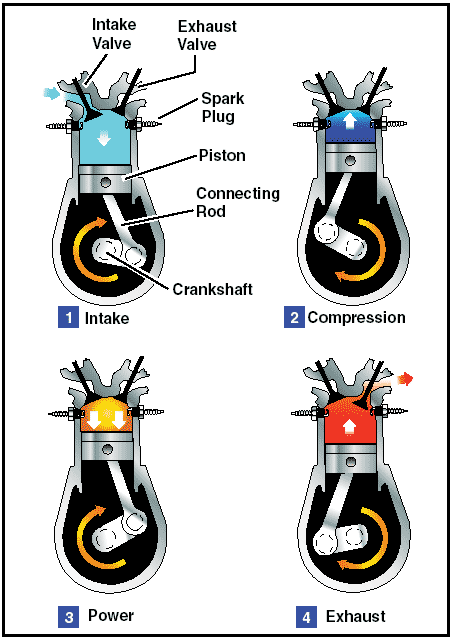
The four stroke cycle is the cycle of a piston in a four stroke internal combustion engine. The first stroke is intake, the piston travels from T.D.C to B.D.C this creates a vaccum, at the same time the intake valve opens and allows fuel and air mixture to enter the cylinder. The second stroke is compression, the intake valve closes and the piston rises compressing the air fuel mixture into the combustion chamber. The Third stroke is power, the compressed air fuel mix is ignited by a spark plug and expands the air in the chamber forcing the piston down. The last stroke is exhaust, the piston moves up towards T.D.C and the exhaust gas is removed out the open exhaust valve. The strokes are repeated.

What does S.I mean?
S.I means spark ignition. where the fuel in the combustion chamber is ignited by a spark plug.

What does C.I mean?
C.I means Compression ignition. Meaning as the air in the cylinder is compressed by the piston it becomes a very high temperature, fuel is then injected into thishot air and it ignites imediately.

When dismantling a carb what precaution should you take?

Always make sure that the float bowl is facing downwards, if turned upwards too much fuel can enter from the float bowl through the jets. and flood the carburettor. Always remember where the parts go! 

How does a bimetallic spring work in a automatic choke work?

The bimetallic spring is a temperture sensitive metal spring that is part of the automatic choke. The spring is attached to the choke butterfly valve. When the engine is cold the choke is on but as the engine warms up the spring unwinds and slowly opens the air intake butterfly valve.

What is the purpose of the venturi and how does it work?
The venturi is a narrowing in the body of the carburettor, it works by compressing the air that is flowing into the carburettor into a smaller space. Its purpose is to compress the incoming air and create a low pressure area around the fuel nozzle which allows fuel to come out.


An engine lacks power. What is likely to cause this problem?
It is likely a problem with fuel delivery, Not enough fuel going through the carburettor to the intake manifold, possibly a sticky valve or dirty fuel nozzle.

How do you adjust the float in a carburetor?
The float tabs on the inside of the float resivoir tank will need to be adjusted to the right height, so that the float is sitting at the right level. A Carburettor float should sit at 16mm

What is the purpose of a power valve?
The power valve is an extra valve which opens and adds more fuel to the circuit when the carburettor is using more fuel, like acceleration or loading.

What are some of the causes of high fuel consumption?
More fuel can be used when there is a problem with the choke like a sticking butterfly valve. Possibly the carburettor float is set at the wrong height which is allowing too much fuel into the combustion chamber, which in turn overfills the fuel nozzle using more petrol.

How is the the idle and mixture screw adjusted?
The idle mixture screw sets the amount of petrol being used when the car is at idle. The screw is simply turned to adjust the amount of petrol used at idle.

When refitting a three mutiple carburettor what should be done after installing them?
Make sure they are all opening together, and that the choke works on all three.